
Frequently Asked Questions
General
Is South Africa safe to travel to – and which regions should I avoid?
South Africa doesn’t have the best reputation when it comes to travel safety, and that’s true. But keep in mind that in the news business, bad news is good news. If you’d like to feel safer, book with us — we keep an eye on things and know the local conditions.
How do I stay safe in Cape Town/Joburg (at night, ATMs, phone, rental car)?
Cape Town and Johannesburg are very different from each other. In both cities, it’s best to ask at your hotel at night which restaurants, clubs, and bars are in safe areas, and to get an Uber there and back. Your rental car is best left parked at night. Your phone has become essential (you can’t even Uber without it!), so keep it with you, but tucked away in a zippered bag against your body. Crime tends to rise especially in December. Use ATMs during the day only, and preferably inside a mall — check there are no loose parts on the card slot.
What is “load shedding” and how will it affect my trip?
“Load shedding” refers to scheduled power cuts. Even scheduled, they rarely start exactly on time, but they usually end on time after about 2.5 hours. There are different stages (up to 8 hours without power…) and an app that lets you plan around it. Many places to stay have gas stoves, so cooking is rarely a problem — South Africans also love a good braai (barbecue) 🙂 Some accommodations have generators that kick in during outages, which can be noisy. A UPS (uninterruptible power supply) is great, since it can at least keep your phone or laptop charged. A solar-powered power bank is also a good idea.
Can I travel solo (solo female travel) – and what should I watch out for?
Yes, you can travel alone. I’ve driven through the country solo many times. There are towns you’re better off avoiding — like anywhere in the world. Kuruman is one, as are Mahikeng and Mthatha. Never follow the car in front too closely, so you can always swerve out if you find yourself in a tricky situation, and always keep your doors locked. “Smash and grab” happens at some intersections — if you’re stopped at a red light there, someone may smash your passenger window and grab whatever’s on the seat. This is mostly limited to the festive season (usually) and to areas I, for one, have never even been to!
Is Uber reliable/safe in the cities – and when might it not be?
Uber is generally safe. You can set up PIN verification for extra security. There are also women drivers now, which I personally prefer as a woman travelling alone.
Entry, Documents & Rules
Do I need a visa – and how long can I stay?
Europeans receive a 3-month visa stamped into their passport on arrival. Your passport needs at least two consecutive blank pages and must remain valid for at least 30 days after your planned departure from South Africa.
What documents do families with children need (entry/exit)?
Children need their own passport meeting the same conditions as above. It’s also a good idea to carry the child’s birth certificate and a consent letter from any parent not travelling with them.
Health
Do I need malaria prophylaxis – and for which regions (e.g. Kruger)?
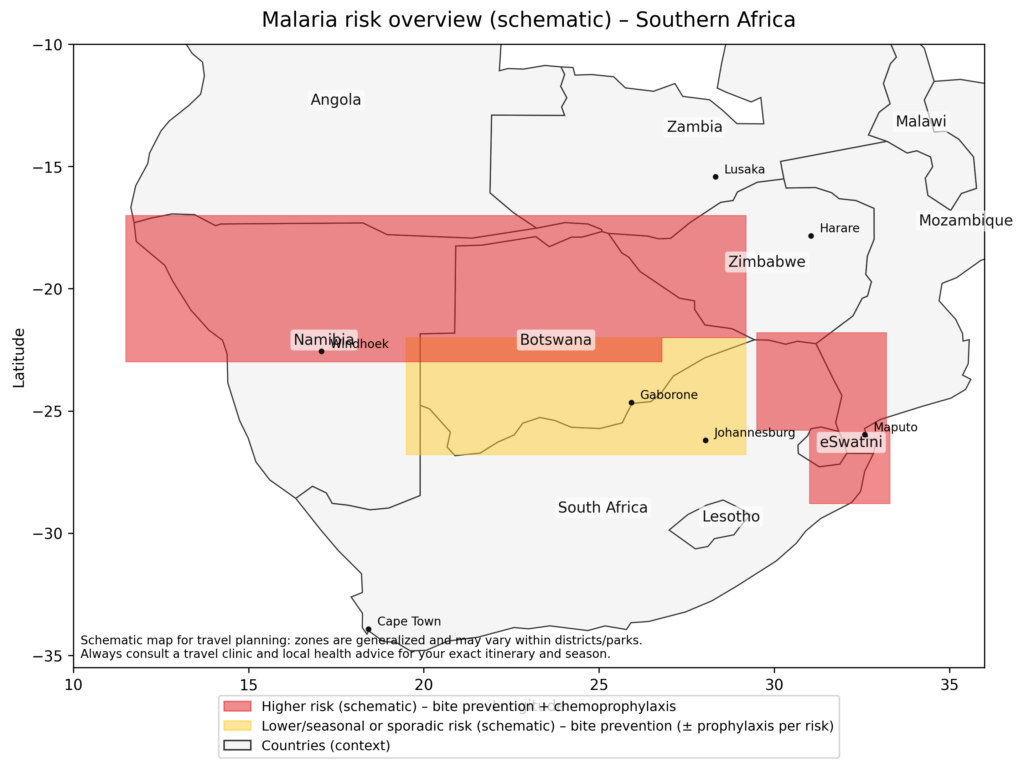
The map below shows which regions carry a risk of malaria-carrying mosquitoes (2025). I always travel without malaria protection myself and haven’t been infected so far. You can apply an essential oil (citronella) and try to keep as much bare skin covered as possible around dawn and dusk. Of course, you can also take a prophylactic medication.
Which vaccinations are worth having (routine, hepatitis, etc.)?
For vaccinations, check your home country’s foreign ministry travel advisory site — for German readers, the Auswärtiges Amt’s South Africa page is a good place to start. I’m not a fan of vaccinations myself, so I’m not the right person to advise on this. One interesting fact: South Africa requires a yellow fever vaccination if you’ve had a layover of more than 12 hours in Kenya or Ethiopia.
Can I drink the tap water?
Tap water is technically drinkable. Honestly, I’m not sure which is worse: BPA plastic bottled water, or chlorinated tap water (if that’s the worst of it…). Spring water is sold in health food shops, which is probably the safest option.
Planning: Best Time to Visit, Routes & Logistics
When’s the best time to visit Cape Town / the Garden Route / Kruger (and why do they differ)?
For the best time to visit, I’d recommend reading this blog post. Every time of year is good, because South Africa has 9 different climate zones — it really comes down to what you’re after.
How many days should I plan for Cape Town?
Cape Town has endless things to offer. For a short, punchy overview (Table Mountain, the northern suburbs, the city centre, Cape Point Nature Reserve, penguins, and the Peninsula), I’d recommend 4 days. I’ve lived here 11 years now and haven’t had a single boring day yet.
How many days do you realistically need for safari (Kruger & private reserves)?
Kruger National Park is a story in itself. If you just want to see the Big Five, this isn’t quite the right place for that, because the animals have plenty of space to hide — which is wonderful, since it’s not a zoo! But if you want to immerse yourself in a landscape as old as the earth itself, see bush all the way to the horizon, and simply can’t get enough of just being in that nature… well then… you already know the answer, don’t you?
Is it worth doing Kruger self-drive, or better to book guided drives?
Rangers radio each other whenever they spot something great. Enough said 🙂
Can I combine beach and safari sensibly, without the stress?
Of course (cheeky grin) — just book with Africanrovers and we’ll take care of the logistics. Otherwise, a domestic flight is recommended, since Durban’s shark-populated waters aren’t for everyone to swim in.
Money, Tipping & Practicalities
Which currency/payment method: card vs. cash – what’s typical?
Unfortunately, cash is on its way out. For several reasons that’s not ideal, though it does make many shops safer, since the chance of being robbed drops close to zero. Please never exchange your home currency for a weaker one back home — you’ll get a worse rate. ATMs are everywhere here, and you can withdraw ZAR (the local currency) with your credit card. Look into getting a good travel card in your home country — one with no fees on cash withdrawals abroad.
How much should I tip (restaurant, guide, driver, housekeeping)?
People in the service industry live off tips — pretty much everywhere in the world. Tipping at restaurants: always 10%, ideally 15%. Guides, parking attendants, housekeeping, petrol station attendants — everyone gets tipped in cash. 20 ZAR is always fine.
What plugs/adapters do I need?
You can buy adapters in South Africa, probably cheaper than back home. And yes — you’ll almost certainly need one.
Getting Around
Is driving a rental car safe in South Africa – and what rules matter most?
The annoying part is that opportunists can spot a rental car at a glance! But if you navigate traffic confidently, know where you’re going (GPS!), and driving on the left isn’t new to you, go for it. At night, only stop when absolutely necessary — including at red lights. Keep your windows down when you come to a stop at intersections; friendly street vendors sometimes toss a hat into your car, and if you drive off without paying for it, there’ll be quite the commotion — even though you never wanted a hat in the first place!
Driving on the left: what to watch for (roundabouts, overtaking, night driving)?
The rule is: left is the new right. As long as someone’s driving ahead of you, you’ll be fine — but leave a European alone on the road, and you’ll spot them immediately ;-). On highways: slower traffic keeps right, overtaking happens on the left. Never drive on a highway — or any road — at night: it’s genuinely hard to see people with darker skin tones after dark, and the same goes for goats, dogs, cows, and so on. It’s already tricky at dusk. Always build plenty of buffer time into your drives (potholes, traffic, the unexpected!).
Domestic flights vs. long drives: when is which worth it?
The Eastern Cape is stunningly beautiful, but getting to those beautiful spots takes real effort. The N2 between Port Elizabeth (Gqeberha) and Durban is, in stretches, simply dull, while towns like Butterworth or Mthatha can be a challenge to drive through. The side roads heading toward the coast are fine for the first few kilometres, but you’ll often need a 4×4 to actually reach the coastline. Stray dogs, seemingly (!) stray pigs and goats, potholes, and roads washed out by heavy rain make for quite the adventure playground. In short: between Durban and Port Elizabeth, you’re better off flying — same goes for Johannesburg–Upington or Johannesburg–Cape Town. If you’d like, we’re happy to show you the Drakensberg and Kimberley region, or the Northern Cape — all beautiful areas, but perhaps a bit much for an Africa newcomer to explore independently.
Safari & Wildlife
When’s the best time to see the Big Five – and how much do the odds vary by region?
Does it really have to be the Big Five? All the other wildlife is just as amazing! Your chances of seeing a leopard are slim. Spotting hyenas is more likely, and just as wonderful! Meerkats are ridiculously cute (ask us about a meerkat experience!). You could of course visit a small Big Five reserve, which is a bit like a zoo, just greener maybe. But do you really want that? Is that really why you travelled all this way? It’s far more exciting to be out on a game drive, scanning left and right from a slow-moving vehicle. Wasn’t that a head behind that bush? Reverse! Ohhh, look — a kudu! Wow, so majestic!
How close do you really get to the animals – and what are the do’s and don’ts?
Every living creature has an energetic zone around it that you should only enter if invited. How would you feel if a stranger suddenly appeared 10cm from your face, uninvited? Whoa — back off! Many animals are far more sensitive about this than we are. Every accident involving wildlife happens because people don’t respect that zone. When in doubt: stay further away!
The animals in Kruger are used to vehicles. What they’re not used to is the silhouette of the vehicle suddenly changing because someone’s leaning out. Always just follow your guide’s instructions.