You often ask me when the best time to travel is. What can I say? It really depends on what you’re after.
For this article, I’m narrowing “southern Africa” down to the six countries we actually travel to:
South Africa
Namibia
Botswana
Zambia
Zimbabwe
Malawi
South Africa
South Africa has several different climate zones all at once — which makes it an ideal destination almost whenever you book. The Western Cape (Cape Town, the Winelands, the Garden Route) gets winter rain: most of the rain falls between May and September, while summer (December to February) is dry, hot, and windy — perfect for hiking and the beach. The northeast (Kruger National Park, Mpumalanga) works the other way around: summer rain from November to March, with spectacular afternoon thunderstorms, while winter (May to September) is dry and mild — and exactly why it’s the best safari season, since animals gather at the few remaining waterholes. Durban and the east coast are subtropical and warm year-round, with most rainfall in summer. In short: somewhere in South Africa, it’s almost always the right time to travel — you just need to know which corner of the country you’re heading to.
Namibia
Namibia is (almost) one giant desert. But boy — what a variety of desert! Rainfall increases from the southwest (0mm) to the northeast (600mm) of the country. Namibia is mostly hot and dry, averaging 300 sunny days a year. Although the northeast (the Caprivi Strip) can get cold at night in winter, temperatures never drop below 0°C there. Windhoek is different — it sits almost as high as Johannesburg and can see frost on winter nights. If you’re sensitive to big temperature swings, Namibia probably isn’t the best fit. In winter, the Namib and Kalahari reach around 25°C in the daytime, but nights can bring frost. As a beach holiday destination, Namibia is about as unsuitable as it gets: the cold Benguela Current keeps the Atlantic water below 19°C, and it cools the coastal air too. On top of that, stubborn fog settles over the coastal strip on roughly 200 days a year. The best months to visit Namibia are between May and October. One especially memorable experience is admiring the Namibian night sky — thanks to the low humidity and virtually no light pollution, the stars come out in force.
Botswana
Three climate zones can be distinguished here. While the north is subtropical, with afternoon thunderstorms in summer (November to March), the southwest is very dry, with less than 300mm of rain a year. The south of the country is sunny nearly year-round — the least rain falls between June and September, which holds for the whole country, including the north. Botswana’s east is occasionally hit by tropical cyclones — most recently in February 2017 (Cyclone Dineo). As with Namibia, May to August are the best months to visit Botswana: that’s when animals gather at waterholes, since all other water sources have dried up. September and October — just before the rains — get very hot, especially in the north.
Zambia
Since Zambia sits on a plateau, temperatures here stay pleasant almost year-round. It’s hot, humid, and rainy from mid-November to March, and dry from April to mid-November. It’s cooler from mid-May to mid-August than from September to mid-November. October is the hottest month. Nights can turn frosty between June and August. The last tropical cyclone to hit Zambia was in 1996 (Cyclone Bonita). Zambia is at its best during the winter months (southern hemisphere) of May to August, when temperatures are pleasantly mild and there’s essentially no rain to speak of.
Zimbabwe
Just north of the Tropic of Capricorn, Zimbabwe also sits on a plateau. There are three seasons here: the rainy season from November to March, the cooler season from mid-May to mid-August, dry and sunny, and the hot period from mid-August to mid-November. Zimbabwe was once known as Africa’s breadbasket, before Mugabe ran the country into the ground. The climate is ideal for growing most crops. Between December and mid-April, tropical cyclones can occasionally find their way here — most recently in March 2019 (Cyclone Idai). So here too, the ideal travel time is May to August. December to February is the least suitable, since things can get quite muddy and humid by then.
Malawi
Malawi sits on Lake Malawi and has a tropical climate with a clear dry and rainy season. It rains from November to April, often in short, heavy afternoon downpours, and it’s hot and humid. The dry season, from May to October, is the best time to visit: from May to August it’s pleasantly mild to cool, especially in the evenings and at higher elevations like the Nyika Plateau, where nights can get properly cold. September and October then turn increasingly hot and dusty before the rains set back in. The dry season is ideal for safari and hiking, while Lake Malawi itself (for swimming and snorkelling) is good pretty much year-round, though underwater visibility can be worse during the rainy season.
There’s a classic South African direction: “At the next robot, you take a left.” Erm, right — and where exactly would I find this robot? Robot is South African for traffic light.
It’s not just the vocabulary that trips you up at first, but also local customs and rules — or the lack of them. But let’s start with the vocabulary. Here’s a definitely incomplete list of things that have their own special name here:
Chommie, Bru, Bro, Cuz, Boet — mate/buddy
Howzit? — how’s it going
Bakkie — pickup truck
Tekkies — sneakers
Braai — barbecue
Gatvol — fed up with something
Kiff — cool/awesome
Babbelas — hangover
How Time Works Here
Cape Town works differently from Johannesburg in this respect. Asking again is always fine, always okay. Maybe mention that you’re a foreigner — then South Africans know what you mean. Because now, now-now, and just now are all wonderfully elastic concepts. “I’ll get them (the documents) to you now” can mean you’ll have them in the next 5 minutes — or that you’ll need to follow up again in a week.
The Incomparable Table Mountain
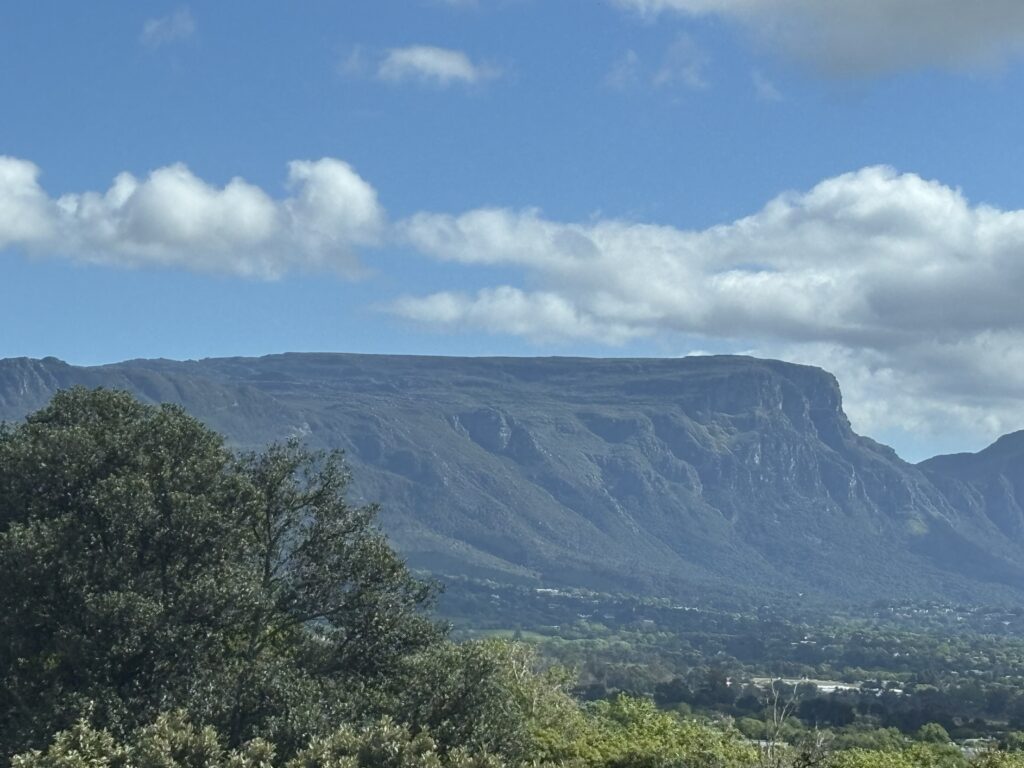
…is stunning. No question. Not many cities have a mountain right in the middle of them. But you shouldn’t underestimate it, or you risk becoming an ALG (another lost German). And the fact that there’s an acronym for this tells you something: it’s a real thing! American tourists tend to think they can climb Table Mountain in flip-flops, and German visitors are often so sure of themselves that they won’t take advice. Sure, these are clichés, but clichés come from somewhere. Please, please be honest about your fitness level and choose your route (there are several) on the Hoerikwaggo trail network sensibly, matched to your abilities. Pay attention to the terrain! But the most important thing, to my mind: coming from the northern hemisphere, it’s completely normal to mix up your directions — that’s totally legitimate. Bring your phone, and check where you’re actually walking. Plan for the possibility that the cableway isn’t running, and that you’ll need to manage the descent on foot too.
Water
Water is life — it’s the most precious thing we have on this planet. Without water, nothing works. South Africa is a developing economy. We can’t keep up! Tourists arrive here seasonally, and the country needs them to survive, but they also put pressure on the very nature they came to see. My own personal request to you: use as little water as possible. Showers: keep them short. Do laundry as rarely as you can. Drinking from the tap is questionable for European stomachs anyway. Wash your car? Why bother? If you see water running down a street somewhere, this isn’t Paris, where that’s just how gutters get cleaned — it’s a burst pipe somewhere. Report it. Tell a local who looks reliable. Take a photo (that always helps). In 2018, Cape Town had a “Day Zero” scenario, and something like that plays out all over the country. At any given time, some region is fighting over water. We need reforestation (things burn down regularly here too!) and water awareness.
Safety in South Africa
Cape Town has become safer over the past 10 years. Pretoria is more unsettled, Johannesburg is busier. Unpredictable acts of cruelty do sweep over the country from time to time like a rogue wave — that’s a fact. Where there’s a lot of poverty, there’s crime. But crime happens most often in the townships, fuelled by xenophobia. Jobs for unskilled workers are limited, and people from neighbouring countries (Zimbabwe especially) are often better trained and more cooperative. That leaves black South Africans falling behind, and some “take revenge” through violence. None of it is pretty…
Don’t stand around holding your phone in your hand — my daughter had hers snatched right out of her hand just 3 weeks ago (Dec 2025).
Don’t wander dark streets at night
Johannesburg has its own, tougher rules, which I honestly don’t know well and don’t especially want to find out about firsthand
Don’t go out alone — especially not hiking (remember: ALG)
If you don’t feel safe, it’s because it isn’t safe! Relearn how to trust your gut
If you’re driving your rental car at night, stick to routes other people are using
Leave NOTHING in the car — not even a water bottle — anywhere
Book with us — and you won’t need to take any of these precautions yourself
Tipping
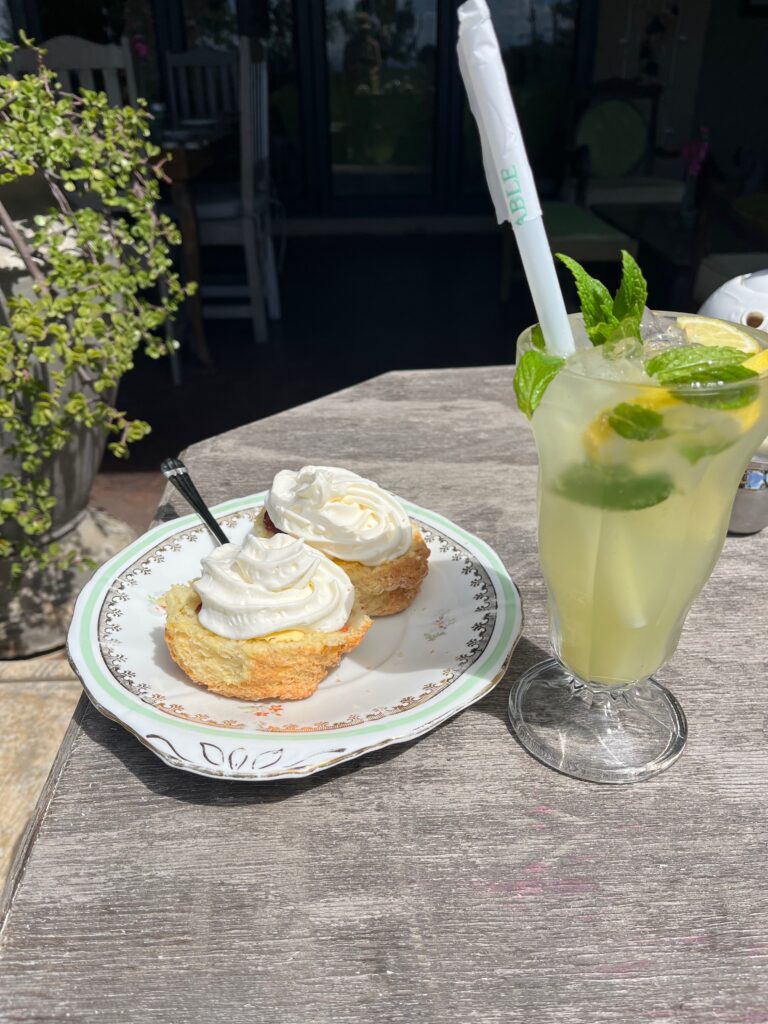
It can’t be said often enough: tip, and tip generously. Even the friendly waitress at Blondies doesn’t earn an hourly wage!!!! Dishwashers in the kitchens earn around 15 ZAR/hour… The people who can actually make a decent living are the car guards in supermarket parking lots — but only if every driver spares 10 ZAR. That’s about 50 cents… The photo, by the way, shows the best scones in Plettenberg Bay, served at Ouland Royale Magical Barn.
Car guard: 10 ZAR
Petrol attendant who cleans your windscreen and checks oil, water, and tyre pressure: 20 ZAR
Your guide, your waiter: at least 10%
If you’re shopping somewhere (farm stalls like “Metro Organics” in Noordhoek village, for example) and your bill comes to 126.35 ZAR, just leave 130 rand and say “put the rest in the tip jar, please”
Friendliness
The baseline attitude of people in this country is friendly. That’s important to know, and as a German myself, I can and will say this: Germany is not a friendly country. Sure, you can smile at people and they’ll smile back. But most people there aren’t used to friendliness anymore and find it intrusive. May South Africa hold on to this basic friendliness — you can help!
Here in South Africa, you can let your smile shine again — unfiltered. No more awkward conversations with dubious characters — just a smile, and move on. A simple human-to-human signal: “I’m good, hope you’re good too.”
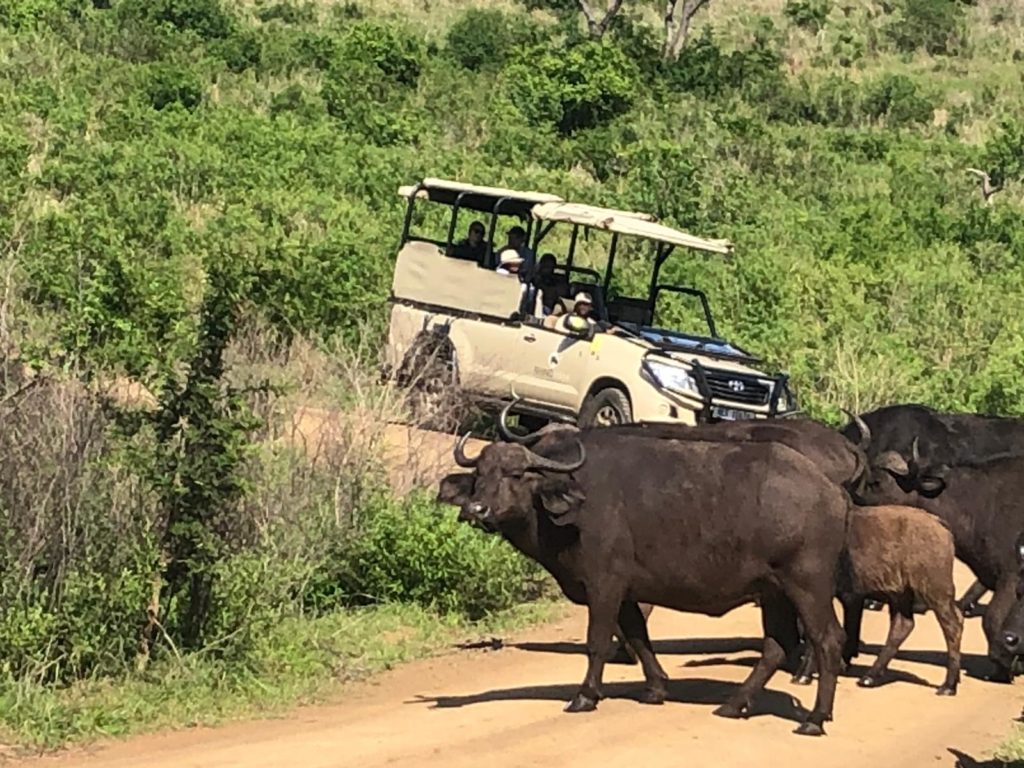
Hluhluwe NP
Safari
Here too, your guide/ranger gets a tip ;-). Please don’t visit parks that are structured like zoos. Aguila is the ultimate cautionary example here. I don’t want to damage anyone’s reputation, but please do look into things like canned hunting and illegal breeding of big cats, and wherever you have even the faintest suspicion: please stay away. Breeding animals so that the mother can later be shot in a cage in front of her own cubs by a more-or-less-skilled hunter is not conservation effort — it’s cruel, and it shouldn’t be supported.
Animal populations are also managed in Namibia, Botswana, and South Africa. Elephants are currently overrepresented and thousands are culled. That’s the sad reality of a world where one species keeps expanding. I have no idea whether money is made from this, but what is certain is that organisations like the Safari Club don’t exactly attract ethically evolved members (one headline on their homepage today, 12 January 2026: “Black bear hunting is how to celebrate 44 years of marriage”).
If you want to see animals, you can do so malaria-free in the Western and Eastern Cape, and of course also in the southern part of Kruger National Park. Sanbona Wildlife Reserve is one such reserve. Across 62,000 hectares, a game drive is still a genuine game drive — the anticipation of the search is the whole point. The cool morning or evening air, the smell of earth and bush, the rising or setting sun, the chirping of cicadas… wasn’t that a tail-tip just now? The essence of safari isn’t seeing or finding — it’s searching. The tension is the experience. Spotting a frustrated lion in a 200-square-metre enclosure is not an experience. We don’t book dubious animal parks, just saying.
Is It Worth Flying to South Africa for Just 14 Days?
Absolutely 🙂 If you’re willing to take one domestic flight, you won’t have any stress at all. In 14 days you’ll get a real overview of South Africa, and you’ll definitely want to come back.
Ideally you’d have three weeks, but even in 14 days you can book with us for around €4,650 per person (calculated for a couple travelling together — it gets cheaper the more people you are). That price includes the international flight, one domestic flight, accommodation (and meals at the accommodations), car, guiding, and driver. Drive times can be hard for newcomers to the country to judge, since delays that are typical here can crop up.
Anyone working a regular job usually has a maximum of 14 days off at a stretch. Sometimes you can plan cleverly around public holidays and long weekends — we know the game. South Africa has a clear advantage as a holiday destination: the time difference to Europe is at most one hour, and in the European summer we’re in the same time zone. Which brings us to the seasons.
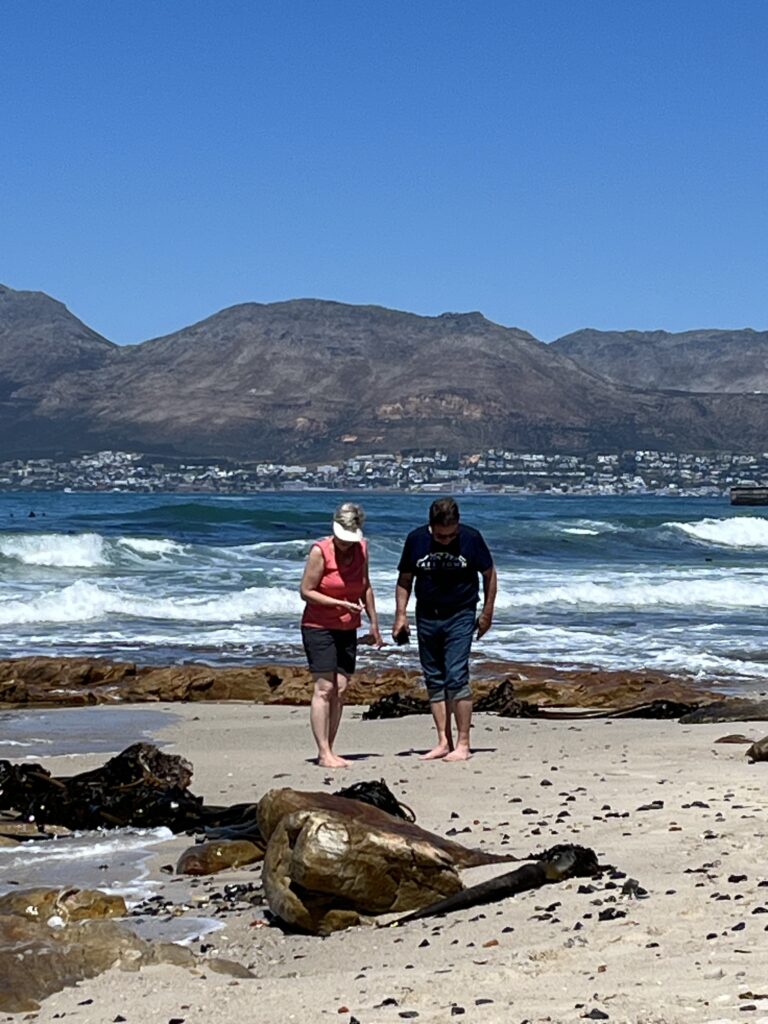
Kalk Bay
When Is South Africa at Its Best?
That question isn’t easy to answer. Take a look at our article on the best time to visit, and you’ll get a first impression. The Western Cape is a bit unpleasant June through September, but great for hiking, since it’s not too hot and you don’t have to start climbing the mountain at 4am just to avoid melting.
December is simply packed. South Africa’s longest school holidays run from mid-December to the end of January — pretty much everywhere is busy.
Durban has pleasant winter weather (June–September), though it’s not to everyone’s taste.
The Garden Route is really lovely during the shoulder seasons — October/November and April/May. If you want to go climbing in the Cederberg, your best bet is local winter, when the rock is easy to grip (December through March, you’ll burn your fingers on it).
Summers in Johannesburg are hot and humid; in the shoulder months and winter, nights can get noticeably cold, though it rarely rains.
The Drakensberg and Lesotho can see snow in winter, which of course has its own special charm.
On the West Coast north of Cape Town, myriad wildflowers bloom in August and September — also stunning.
Which Route Suits You?
Most visitors to South Africa want to marvel at the incredible wildlife — of course. But anyone who’s been here a few times knows that’s only a fraction of what the country has to offer.
The classic of all routes is the Garden Route — this stretch has its own appeal year-round, but especially from January to May. Depending on the month, you’ll start or end the trip in Cape Town and spend 4–5 days in the Mother City to get a real feel for it.
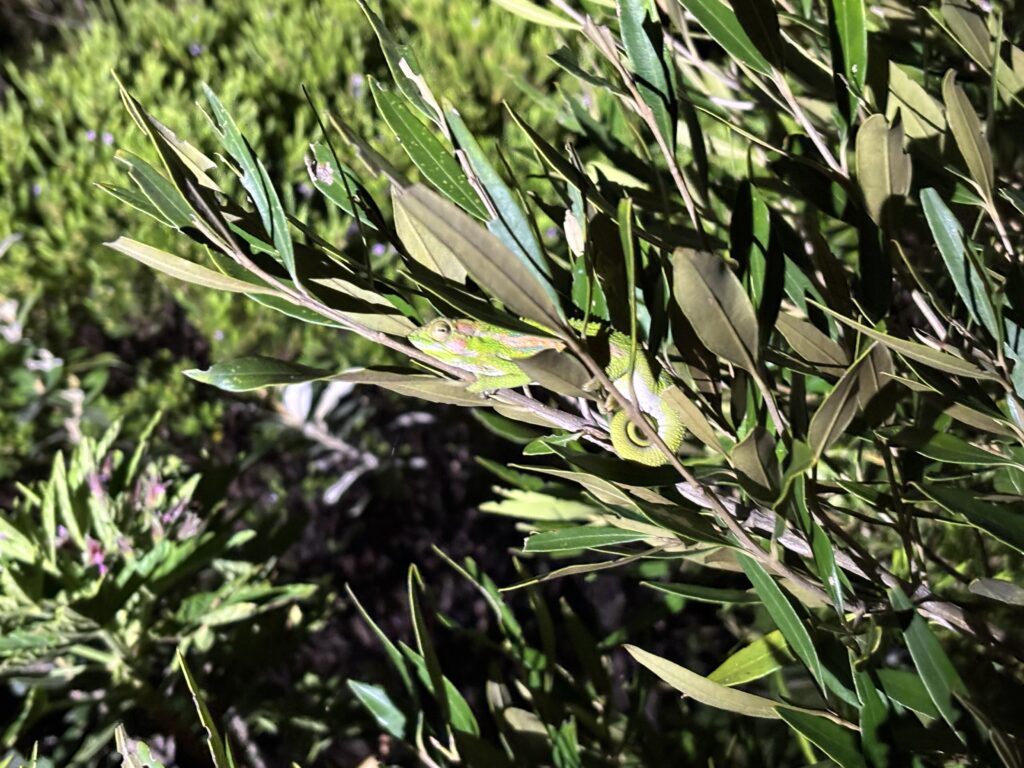
This is where a local tour operator really matters — local is lekker! Of course you can chase down every spot mentioned on Instagram and elsewhere on your own, but only someone who actually lives here can give you a truly personal experience. On our last tour, for example, a friend and I took our guests out chameleon-spotting at night — an unforgettable and genuinely unique experience, since you need to know exactly where the chameleons hang out to find them — or we’ve taken guests to a live concert, and so on.
The Garden Route, Extended
You can drive from Cape Town to Gqeberha or the other way around. Extending the route further northeast is also a lovely idea. Why not start in East London? That stretch isn’t technically the Garden Route anymore, but it’s still relatively undiscovered by tourists. Which means: let’s keep this between us — lower prices and more relaxed travel.
From East London, you take the R72 along the coast, detouring down side roads to the sea wherever you like. This coast is a paradise for horse riders, and you could easily spend a few days here already.
Then spend a night in Kenton-on-Sea at one of the three Big Five game reserves there and experience safari without any malaria worries. Or maybe you’d rather push on to Gqeberha (Port Elizabeth) on day one? Addo Elephant National Park is right on the way, as is Shamwari, another Big Five reserve. From there it’s an easy drive on through Jeffrey’s Bay and St. Francis to Storms River, where you can hike, kayak, and bungee jump.
You might fancy a detour into the Baviaanskloof mountains? That’ll cost you at least 3 days, and you won’t see many other travellers there.
Plettenberg Bay is always worth a stop and an overnight stay. Barringtons on Piesang Valley Road is our tip for dinner, and after a hike on the Robberg Peninsula, the scones at Ouland Royale Magical Barn taste absolutely out of this world!
Old Nick is a lovely rest stop — treat yourself to a linen pair of pyjamas from Mungo, who have their weaving mill right there!
In Knysna, the Heads are of course the highlight. The natural harbour entrance is a real visual treat. You could easily spend days here too, but passing through is lovely as well.
Staying overnight in Wilderness is wonderful, because during whale season you can watch these majestic animals right from your bed. Then a coffee in the little town (you can walk there!), and dinner at Salinas is also just a short stroll from the hotel we’ll book for you there ;-).
From Wilderness, you’ll need to decide whether to continue via Mossel Bay or Oudtshoorn. So we’ve split the route into two options here.
Day 1: Cape Town to East London (flight), then 2.5-hour drive to Kenton-on-Sea, or
Day 2: on to Kenton-on-Sea, 2.5-hour drive
Day 3: relax in Kenton, or you’ve booked into one of the game reserves
Day 4: game reserve, or on to Addo Elephant National Park, 2-hour drive
Day 5: Jeffreys Bay or St. Francis Bay, or still in Addo — 3-hour drive
Day 6: Storms River, 1.5-hour drive
Day 7: Storms River for hiking, kayaking, and the like
Day 8: Plettenberg Bay, 1-hour drive
Day 9: Wilderness, 1-hour drive
Via Oudtshoorn
It’s a fair bit of driving, but worth it! The hinterland — the Little Karoo — is breathtakingly beautiful. Wide skies, dead-straight roads (the R62), ostriches, the Cango Caves, and meerkats are all waiting to be discovered. You might even want to push on into the Great Karoo and over the Swartberg Pass? Prince Albert, at the northern end of the Swartberg Pass, is a charming little town with great coffee milkshakes. From Prince Albert you take the N1 to Laingsburg, then over the Seweweekspoort Pass to Barrydale, where I’d recommend spending the night. Again: fantastic coffee milkshakes at the Blue Cow Café, sensational bread at the Karoo Hotel, and the food at Mez Karoo Kitchen is simply outstanding. The nicest place I’ve stayed there was The Karoo Moon House and Cottage on Hill Street — really stylish. The towels at that guesthouse come from the local weaving mill, and you can buy their MUD skincare on the R62 at the eastern edge of town.
You’ve probably guessed: I’m a Barrydale fan.
The Tradouw Pass then takes you over Suurbraak [ˈsœːrbraːk] — the double ‘u’ is pronounced somewhere between a German ‘ü’ and an ‘i’ — on to Swellendam. Bontebok National Park isn’t especially remarkable, but an afternoon in the park along the Breede River is still worthwhile. If you take the road to Bredasdorp, you’ll reach the southernmost point of the African continent: Cape Agulhas.
The fishing villages of Arniston and Struisbaai are lovely, and then it’s really time to head to Cape Town! But… Stanford (croissants at Ou de Meul) and Hermanus are still in between, and both are worth a stop, especially during whale season. In Hermanus, you don’t even need to get out on the water to see whales between June and November — the beautiful 6.8km coastal path, completed in 2025, gives you views of these marine giants right from the shore. And of course, you have to stop to eat at Dutchies at Grotto Beach. Lunch, dinner, or both 🙂
Day 10: Oudtshoorn/Prince Albert — 1-hour drive from Wilderness to Oudtshoorn, or 3 hours to Prince Albert
Day 11: Barrydale — 4.5–5 hours from Laingsburg over the Seweweekspoort Pass
Day 12: Cape Town — 5-hour drive from Barrydale via Cape Agulhas to Cape Town
Day 13: Cape Town
Day 14: Cape Town
Via Mossel Bay
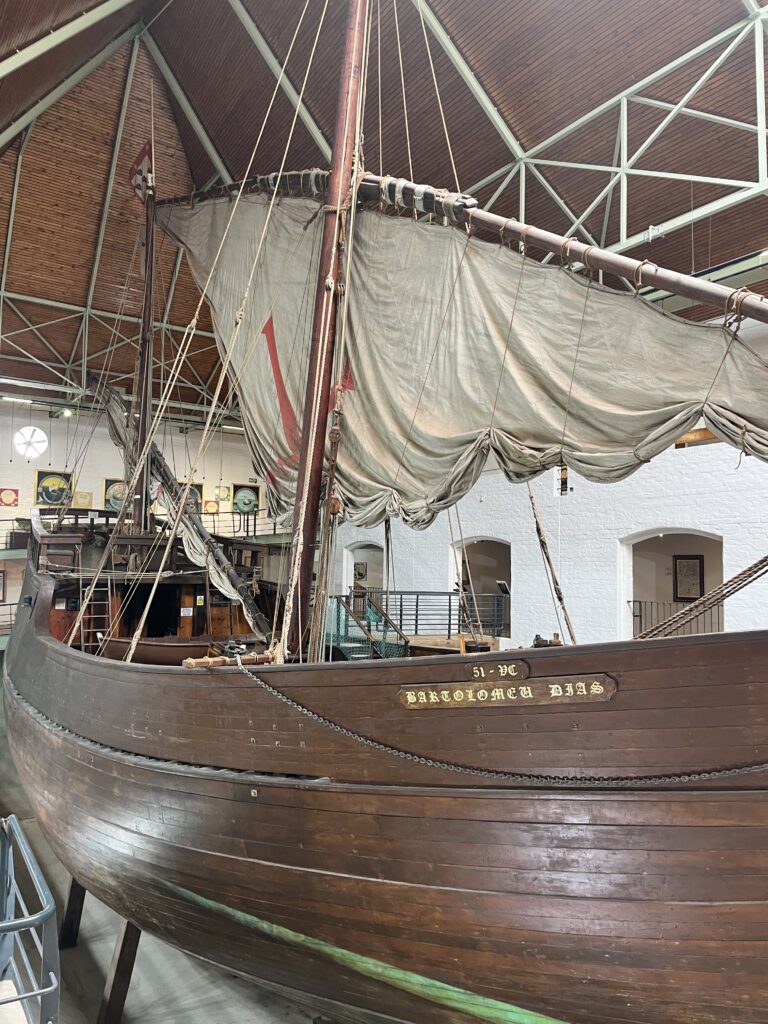
Full disclosure: I’m not a huge fan of Mossel Bay. The Bartolomeu Dias Museum Complex is pretty cool, though — it has a replica of Dias’s ship and just about every kind of shell ever found in South Africa. For shell fans: an absolute must!
You can also spend the night in a decommissioned train carriage at Santos Beach, and book a zipline in Mossel Bay. Speaking of ziplines: the best one in the country is up north near Tzaneen. There, you zip back and forth across the river 11 times — genuinely beautiful.
Mossel Bay has a fair amount of petrochemical industry, so it doesn’t smell great, and the view isn’t exactly stunning either.
Back on the N2, you can then follow the same route described under the Oudtshoorn option above.
Day 10: Wilderness to Mossel Bay, 1-hour drive
Day 11: Mossel Bay to Cape Agulhas, 4-hour drive
Day 12: Agulhas to Cape Town, 3-hour drive
Day 13: Cape Town
Day 14: Cape Town
How Do You Keep the Costs Down on a 14-Day Garden Route Trip?
Accommodation is of course one way to keep your trip’s costs down. This route genuinely has everything, from budget to top-end. If you buy a tent and travel from campsite to campsite, it’s a really affordable option that can be a lot of fun too.
Among fixed accommodations, especially in Wilderness and Plettenberg Bay, there’s barely a ceiling at the top end, but there are also affordable guesthouses.
Airbnb is of course always an option, but honestly, once I realised how unaffordable it’s made the rental market for locals, I stopped thinking it’s a good idea.
A local alternative to Airbnb is Lekkeslaap.
Eating out in South Africa is comparatively cheap, and at the time of writing (December 2025) you can expect to pay around 300 ZAR for a good meal with a glass of wine.
In our next post, we cover ideas for a 14-day South Africa road trip that includes Kruger National Park.
Is South Africa a Dangerous Country?
South Africa has topped the crime statistics for years. But what’s it really like on the ground?
I’ve lived here for 11 years now. That’s not a very long time, but long enough to get a real sense of what it’s actually like.
Four months and ten days after we moved into a house in our new home, we were robbed. During the break-in it quickly became clear that the two intruders didn’t actually want to hurt us — they were just after things they could easily resell. Still… not a very pleasant experience.
Photo by Maxim Hopman on Unsplash
A friend was mugged in broad daylight on Loop Street (central Cape Town) and robbed of his yoga mat, wallet, and phone.
My children witnessed pickpockets in the city more than once, at night, coming out of clubs.
A friend of my daughter’s was raped and murdered while out on a walk with her family.
In short: yes, there is crime at every level here — just as there is in the rest of the world.
How can you protect yourself from this?
In the case of our own break-in, it’s simple: do your research first, then rent the house. Our landlady hadn’t told us the house we were renting from her had already been broken into seven (!) times before. We’d moved to Cape Town in peak season, when everything is booked out and anyone with even a spare room jumps on the Airbnb bandwagon. I simply hadn’t been able to find another house that worked for us…
The house was in an area next to a large township — the term used for Black South Africans’ formal or informal settlements. Because of the tensions and poverty in townships, break-ins happen more often in neighbourhoods near a township than in suburbs without one.
Crime in the city centre is easy to avoid — you simply don’t go :D. Or you follow the universal rule: don’t flash wealth around, and stay alert. Develop a sixth sense and trust your gut: if an area looks dodgy, it probably is!
Going out at night in Cape Town is a bit of a thing. Again, it really depends on which area you’re in. In the city centre, you call an Uber and only leave the club or restaurant once the driver is right outside. Then you step out, and the doormen keep an eye on you until you’re in the car.
That would be my advice to tourists.
These days I have absolutely no problem going to the Labia cinema alone in the evening and parking on a side street. The ‘park guards’ are usually nice guys — they don’t necessarily watch your car, but they’re there.
And of course, nowhere in the world are you immune to being in the wrong place at the wrong time — you can file that under fate, and as traumatic as such experiences can be, they’re simply beyond our control.
Like the ranger at Mount St. Helens who happened to have the day off when the volcano erupted, only to die in a volcanic eruption in Japan eleven years later (Bill Bryson, ‘A Short History of Nearly Everything’).
South Africa is a fantastic country, and if you act sensibly, it’s no more dangerous than plenty of other countries. You’ll find more answers in the FAQ section here.
In short:
Check out the area before renting or buying a house or flat
Never play the hero — hand over your phone or money right away
Always stay aware of your surroundings
Don’t show off any ‘valuables’ (camera, jewellery…)
Safari in Southern Africa
There are countless ways to go on safari in southern Africa. The first question you should ask yourself is:
What kind of safari trip do I want?
By that I mean:
Do you want a raw, exciting experience (sleeping in unfenced camps, staying in places only reachable by 4×4 — here we ask: “Are you prepared to rough it up?” — maybe no water for showering and a campsite with no toilet …)? You might wake up because lions have wandered into camp — you could get hurt.
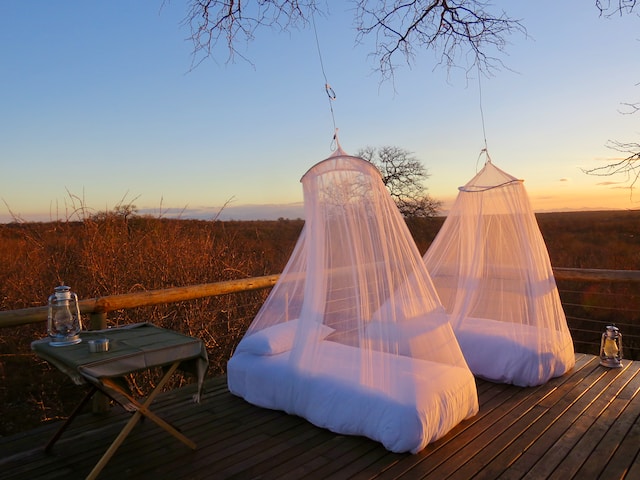
Do you want to experience the same remote landscapes and wildlife, but in relative luxury (your tent and even a bush toilet set up for you, hot water prepared for washing, meals cooked for you, and you sit down at a table with a white tablecloth in the middle of pristine wilderness)?
Do you want to travel in a ‘safe’ area (Kruger Park, private reserves), where you can choose between camping and a solid roof over your head, but cook your own food (or eat at a restaurant) and do the game drives with us yourself?
Or do you want to stay in a lodge and experience the game drives with a ranger, all meals included? Carefree, in a malaria-free area?
We can offer you all of these options 🙂 though we sometimes bring other tour operators on board, especially for trips outside South Africa.
People who have run a tour operating business in one place for many years know the local conditions best — and which animals to find where.
Which brings us to the next point:
What do you want to see?
Do you want a wilderness experience with no guarantee of animal sightings (well, you can’t really see no animals here — thank goodness!)
Do you want a Big Five guarantee and just tick them off: lion — check, elephant — check
Do you want an educational experience — a guide who can answer all your questions about the local flora and fauna?
Most important of all is that you talk to us completely openly — not just about what you want, but about your budget too. Option 1 is affordable compared to option 2, because campsites are much cheaper and there’s no exclusive service, just the basics: planning, driver, guide (usually the same person), food, and accommodation. Option 2 is the most expensive and most luxurious version — a beautiful, glossy-magazine kind of experience, best had in Botswana or Zambia. Options 3 and 4 are the norm — what most first-time visitors ask us for.
But why not start out a little more adventurously?
A trip into the Kgalagadi Transfrontier Park, for example, is real adventure and affordable — but needs to be booked well in advance, since the few campsites fill up quickly, especially with locals, as this park is a bucket-list trip for South Africans too. Driving a 4×4 on dusty tracks gives you the real Africa feeling, not to mention the evening silence broken by lions roaring (hopefully from a distance) and a sundowner drink. We travel with rooftop tents, so the kind of things you see on YouTube don’t happen to you. These vehicles also need to be booked ahead and cost a bit more than a normal rental car. If you’d like to drive yourself, we can organise a convoy trip, which is safer than driving alone — for example if you get your vehicle stuck in the sand or break down and need help to keep going.
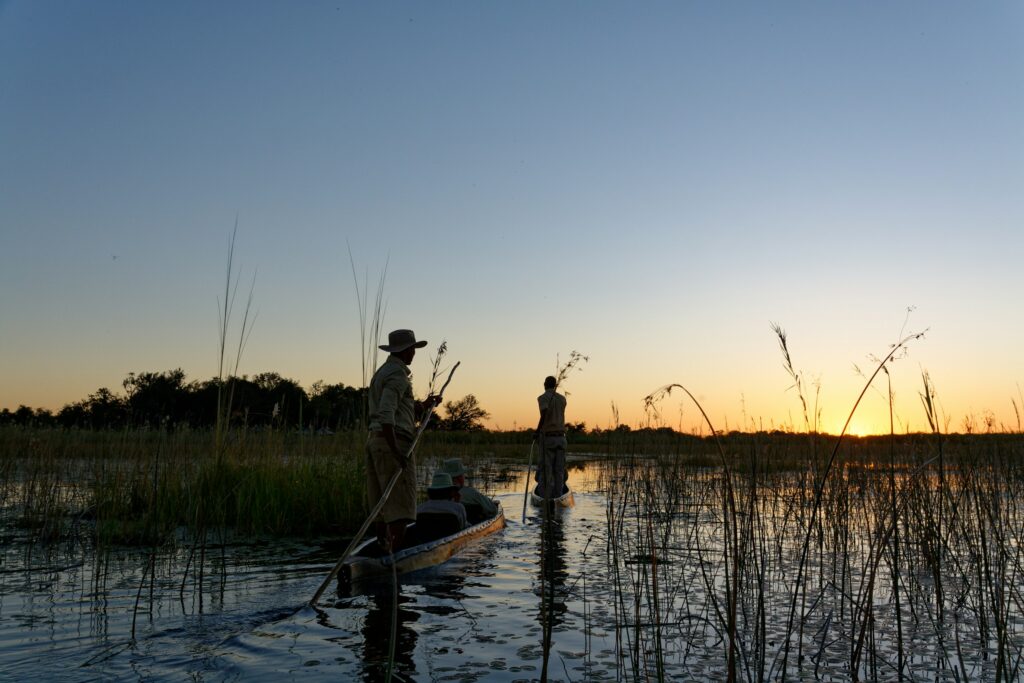
You’ll certainly find the most luxurious version of a safari in Botswana or Zambia. We have contacts there 🙂 and it’s always wonderful to organise and accompany a trip like that. When you get back to camp after a full day’s walk or a mokoro trip through the Okavango Delta, hot water is already waiting outside your tent, a fire is crackling, the food smells irresistible, and the sun is low — there are few moments quite like it.
The best time of year?
…is always when the trees are bare and the grass is dry, because that’s when you see the animals best. Depending on the region, that also means cold nights and mornings.
In the southern hemisphere’s summer, when it’s hot and green, there are also more insects — which has spoiled the mood for one or two people — but fewer tourists.
The best time of year is simply whenever you happen to be travelling. There will always be something special to see, no matter when you visit southern Africa.
What do you need for the perfect safari?
Bush-coloured clothing, especially if you’ll be out on foot
Binoculars — an absolute must-have
Sturdy ankle-high shoes and, depending on the region, gaiters — they protect you from snake bites, but also keep sand out of your shoes!
A hat — better than a cap — with a wide brim and neck protection
Sunscreen — whatever season you visit, since a South African winter is still sunnier than a European summer
A water bottle you can carry over your shoulder (for bush walks)
If you have questions about safari in southern Africa — send me an email: more@africanrovers.com
If you ask me when the best time to visit South Africa is, I really should answer: “whenever you can travel.” But yes — depending on whether you’re thinking wine, whales, wildflowers, or a Big Five safari, some months suit better than others.
So you can plan properly, let’s go month by month through what to expect — with a focus on:
the Cape region & Garden Route
Kruger & other safari regions
domestic flights & school holidays
specials like whale season and wildflower carpets on the West Coast
South Africa’s climate zones
Very roughly, you can split South Africa into four travel zones — even though the country actually has 13 distinct climate regions!
Cape region & Garden Route — Mediterranean: rain and cold mostly in the (South African) winter, so June–August, with mild, dry summers.
Kruger & Lowveld — summer-rainfall: hot and stormy from Nov–March, dry and cool from May–Oct — which is also the classic safari high season.
KwaZulu-Natal & the east coast — more subtropical, warm and humid, the sea is swimmable almost all year round.
Interior / Highveld (Johannesburg, Drakensberg, Karoo) — dry, sunny winters with cold nights, summer thunderstorms especially in January.
With that picture in mind, let’s go through the year.
January – peak summer & peak season
Cape region & Garden Route
It’s summer holiday season in South Africa — beaches are packed, accommodation and domestic flights are pricey and book out fast.
Expect 25–30°C during the day, sometimes more. Perfect for the beach, wine country, mellow evenings by the sea — though it can still get seriously windy!
Hiking is doable, but better early morning or late afternoon.
Kruger & safari regions
Hot, humid, afternoon thunderstorms, lots of green.
Animals spread out because water is everywhere — you’ll tend to spot them more in open areas and along roadsides.
The upside: lots of babies, great photo contrasts, and superb birding.
Flights & prices
Peak season — national holidays, international visitors, Christmas/New Year.
If you can, avoid the period up to around the second week of January — or book very early.
Who’s January good for? Sun worshippers, sea-and-swimming fans, and anyone who loves the heat and doesn’t mind everywhere being busy.
February – warm, summery, a bit quieter
Cape region & Garden Route
Still full-on summer, and often more settled than December.
Fewer local holidaymakers, but still the best beach and wine weather around.
Kruger & safari regions
Still the rainy season, but often a bit less stormy than January.
Green and dense, but with beautiful light and spectacular cloud formations.
Flights & prices
Still fairly in-demand internationally (plenty of Europeans escaping winter).
Domestic flights ease off a bit compared to Christmas, though it’s still not a “budget month.”
Good for you if … you love swimming, want long evenings outdoors, and handle heat well.
March – golden late summer
Cape region & Garden Route
One of my favourite months: warm, but no longer brutally hot, often less windy too.
Ideal for hiking, road trips, and wine tasting — all at pleasant temperatures.
Kruger & safari regions
A transition: still green, but the rain is easing off. Evenings can bring the first cooler breezes.
Lots of baby animals around, birdlife at its best.
Flights & prices
The further you get from European winter holidays, the calmer things get.
Easter can bring another price jump depending on the year — worth keeping an eye on.
Perfect if … you want to combine Cape Town, the Garden Route, and a first safari, without extreme weather.
April – autumn colours & calmer travel
Cape region & Garden Route
Gentle autumn mood: clearer air, often gorgeous sunsets.
Mild during the day, you’ll definitely want a jacket in the evening.
Great for active travel: hiking, kayaking, cycling.
Kruger & safari regions
Rain is tapering off, the dry season is announcing itself.
Grass gets shorter, waterholes and pools become more important — game viewing gets easier.
Flights & prices
Outside of Easter: fairly reliable shoulder season — decent odds of reasonable rates.
Ideal for … people who prefer mild temperatures and want neither packed beaches nor bone-dry bush.
May – the start of safari high season
Cape region & Garden Route
The turn toward winter: more rain fronts possible, but still plenty of sunny days.
Fewer tourists, a cosy mood in Cape Town and the Winelands.
Kruger & safari regions
The classic dry season begins — pleasant days, crisper nights.
Vegetation thins out, animals get easier to spot, fewer mosquitoes.
Flights & prices
Not a major South African holiday month — good if you’re flexible.
Especially exciting if … you love safari but want to avoid the really cold July nights.
June – whales & winter sun
Cape region & Garden Route
Officially winter, but: on many days you’ll get blue skies, clear air, and 15–20°C.
Whales incoming! From June, the first southern right whales start showing up off Hermanus, De Hoop, and elsewhere.
A great time for wine, good food, museums, cosy cafés — and beautiful hikes on sunny days.
Kruger & safari regions
Right in the middle of the dry, cool, wildlife-rich period.
A beanie and gloves aren’t a bad idea in an open jeep in the morning, but daytime temperatures can be perfect.
Flights & prices
European summer is starting, but for South Africa this isn’t a classic peak — often good deals heading south from Europe.
Who’s June ideal for? Anyone combining safari + Cape Town who’d rather pack a fleece than roast at 35°C.
July – clear air, best safari
Cape region & Garden Route
Often the wettest stretch runs between July and August — but rain tends to come in bursts.
On dry days: spectacular visibility, fewer people on the trails, cosy evenings by the fire.
Kruger & safari regions
Prime time for game drives: dry, short grass, animals gathering increasingly at waterholes.
Nights are cold, days are pleasant.
Flights & prices
July is school holiday time for many South Africans, and international travellers take advantage too.
Domestic flights and popular lodges can be fuller and pricier.
Who should come in July? Safari nerds, photography fans, and anyone who loves that “campfire winter” feeling.
August – wildflower carpets & safari still dreamy
Cape region & West Coast
Now it gets colourful: wildflower season on the West Coast, especially in West Coast National Park and toward Namaqualand (depending on the rains).
You can go from “grey and stormy” to “postcard blue” in a single day — classic Cape winter.
Garden Route
Changeable, but still mild; lots of green, lush vegetation.
Kruger & safari regions
Still prime time: very good wildlife sightings, little water left in the bush, plenty of animals gathering at rivers and dams.
Flights & prices
Just before South Africa’s spring rush, though there are still some winter specials in the Cape.
Perfect for … travellers who want to combine flowers + safari and don’t mind the odd rain front. The Western Cape winter is genuinely uncomfortable, though. Plenty of Europeans say they’ve never been as cold as during a Cape Town winter — mostly because the houses are poorly insulated and have no central heating, since Capetonians tend to simply deny that winter is happening.
September – whales, flowers & almost summer
Cape region & Garden Route
One of the best months, full stop:
The last weeks of wildflowers on the West Coast — depending on the rain, some years barely produce any.
Peak season for southern right whales around Hermanus and the Cape Whale Coast.
In Cape Town, sometimes the first early-summer days.
Kruger & safari regions
End of the dry season — hotter, dustier, wildlife sightings at their peak.
Flights & prices
Plenty of Europeans arrive now (autumn school holidays), but not quite as intense as over Christmas.
Domestic flights can tick up, but not yet at maximum prices.
If you want “everything at once” … September is an excellent month for Cape Town + Garden Route + safari, with a huge number of nature highlights.
October – between spring and early summer
Cape region & Garden Route
Days get longer, the sea is still fresh, but the beaches are already calling.
A great time for road trips, hikes, and wine country — before everyone arrives in December.
Kruger & safari regions
Hot, dry, often dusty; the first thunderstorms can arrive toward the end of October.
Wildlife viewing is still excellent, but temperatures are climbing.
Flights & prices
Shoulder season: lovely if you can plan a bit more flexibly.
Good for … travellers who want to experience Cape Town in a T-shirt while avoiding peak season.
November – early summer heat & the tail end of whale season
Cape region & Garden Route
Early-summer feel, with still-decent chances of whale watching along the coast, especially Hermanus/Walker Bay.
A great time to be both active and relaxed: beach, wine, Cape Point, Table Mountain.
Kruger & safari regions
Summer is on its way: hotter, humidity rising, the first heavy showers.
The landscape turns green again, the first babies appear, wonderful contrasts for photography.
Flights & prices
The closer you get to Christmas, the busier and pricier it gets — booking early pays off, but only really if you don’t mind packed beaches, packed restaurants, packed bars and so on. Otherwise December is genuinely rough.
December – packed beaches, packed lodges
Cape region & Garden Route
Peak summer: South African school holidays, international visitors, Christmas on the beach.
Mood: cheerful, colourful, loud — but also, admittedly, full.
Ideal if you want to spend the holidays in the sun and enjoy a bit of buzz.
Kruger & safari regions
Summer rains, heat, thunderstorms.
More green, tougher visibility, but a wonderfully lush, lively landscape full of young animals.
Flights & prices
The most expensive time of year for flights and many domestic routes.
Who’s December for? People who say: “I want to sit barefoot on the beach at Christmas — whatever it costs.”
So — now what?
The honest answer: the best time to visit South Africa depends on you.
If you love safari: May–September.
If you want Cape Town & the Garden Route in summer mode: October–March.
If you’re after whales & wildflowers: August–October.
If you prefer the quieter shoulder season: April, May, June, and partly October/November.
If you’d like, send me:
a rough time frame,
what matters most to you (safari, sea, whales, wine, hiking…),
and your approximate budget —
and I’ll put together a concrete sample route that matches your own personal “best time to visit South Africa.”
Kruger National Park is always wonderful
This 14-day route is for anyone who wants to experience South Africa intensely, without changing location every single day. You start in Johannesburg, drive via Tzaneen into Kruger National Park, and spend four nights there (north to south). From there it’s either the Panorama Route around Graskop, or straight on to eSwatini (Mlilwane). To finish, KwaZulu-Natal awaits with St Lucia (iSimangaliso Wetland Park), and depending on what you fancy, Sodwana Bay, Hluhluwe-iMfolozi, or a short detour into the Drakensberg, before you wind the trip down in Durban.
If you land early in Johannesburg, you can already push some distance north on arrival day. If you land later, it’s worth spending your first night in Johannesburg (ideally at the airport), so the trip starts relaxed rather than rushed.
Quick Facts
Start: Johannesburg
Duration: 14 days / 13 nights
Safari focus: 4 nights in Kruger (north to south)
Nature upgrade: eSwatini’s Mlilwane (2 nights)
Coast: St Lucia (2 nights), optionally Sodwana or Hluhluwe
Finale: Durban, or the Drakensberg as an alternative
Optional in Kruger: ranger game drives, night drives, morning walks
Kruger NP
Day-by-day plan
Day
Route and base
Overnight
Highlights
Optional
1
Arrive Johannesburg
Johannesburg, or push on (depending on arrival time)
Settling in
Overnight for late arrivals
2
Johannesburg to Tzaneen
Tzaneen
Easing into the Lowveld
Zipline if timing allows
3
Tzaneen into Kruger (North)
Kruger North
First safari, quiet in the north
Evening ranger drive
4
Kruger North
Kruger North, or transition toward central
Finding your safari rhythm
Morning walk or night drive
5
Kruger Central
Kruger Central
Different landscape, different dynamic
Evening ranger drive
6
Kruger South
Kruger South
Classic Kruger, your last full safari day
7
Exit Kruger toward Graskop OR straight to eSwatini
Graskop
Entering the Panorama Route
God’s Window, if the light is good
8
Graskop highlights, then on to Mlilwane
Mlilwane, eSwatini
A complete change of pace from safari
Bourke’s Luck Potholes
9
Mlilwane, full day
Mlilwane, eSwatini
Nature, slowing down, buffet dinner
Horse riding, hiking, pool
10
Mlilwane to St Lucia
St Lucia
Arriving by the water, easy evening
Side trip into other eSwatini parks
11
St Lucia and iSimangaliso
St Lucia
Wetlands, beach, wildlife
Estuary boat tour, beach walk at Cape Vidal
12
St Lucia to Sodwana OR Hluhluwe-iMfolozi
Sodwana or Hluhluwe
Coast or an extra safari
Snorkelling or a game drive
13
Toward Durban
Durban
City-and-coast finale, winding down
Drakensberg instead of Durban
14
Depart Durban
—
Journey home
Optional extension
Variant without Graskop: go straight to Mlilwane on day 7, and use the “night you’ve gained” for Sodwana, Hluhluwe, or the Drakensberg (whichever you’re after — more sea, more safari, or more mountains).
Why you should plan four nights in Kruger
Many routes make the mistake of treating Kruger as “one stop.” In reality the park is a whole world of its own. When you book a safari with us, we want to know exactly what you have in mind, so you’re never disappointed. Four nights give you:
enough time to actually live the safari day-rhythm (out early, rest at midday, out again later — the same way the animals do it)
the chance to really savour north to south, instead of just “driving through”
room for optional highlights like night drives or morning walks (depending on what the camp offers)
Kruger north to south: how to use the time well
So the safari doesn’t turn into a race for kilometres, this logic tends to work especially well:
1) Starting early is best
The best hours are almost always morning and late afternoon. Plan the middle of the day as a break. The animals do the same, so it’s not wasted time — no FOMO needed.
2) Less distance, more time watching behaviour
If you drive slower and deliberately combine loops, you see more. A lot of sightings don’t come from “luck” — they come from patience and timing.
3) Ranger drives as an upgrade
Self-drive works very well in Kruger. A ranger game drive can be a strong addition though, because rangers often bring more context (reading tracks, behaviour, being in the right place at the right time) and share sightings with each other over the radio.
4) Night drives and morning walks — organised only
Night drives and walks are fantastic, but only where they’re officially offered and led by qualified rangers. That’s the safe, sensible setup.
Panorama Route, Graskop
If you decide on Graskop:
God’s Window is only worth it when the light is good and visibility cooperates — otherwise you’re just staring into a wall of mist
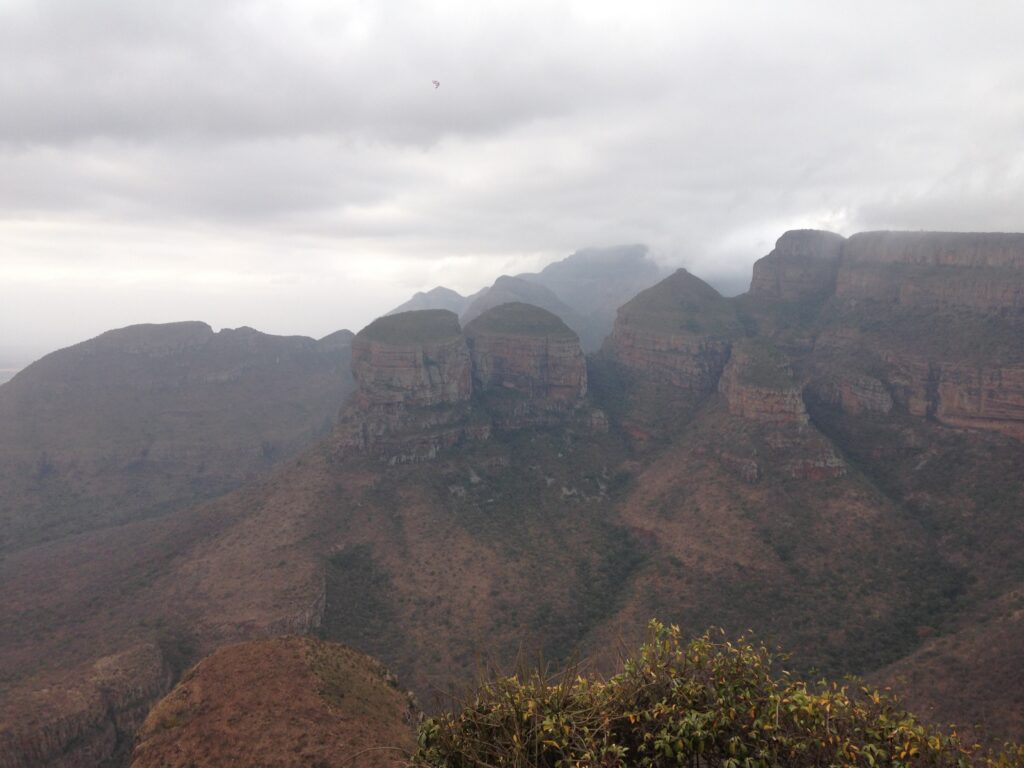
Bourke’s Luck Potholes is fun — you can also spot the ‘Three Sisters’ rock formation from there
consider one viewpoint loop rather than “stopping at every single one”
If time is tight, or you’d rather have “more nature, fewer viewpoints,” driving straight to eSwatini is often the better call.
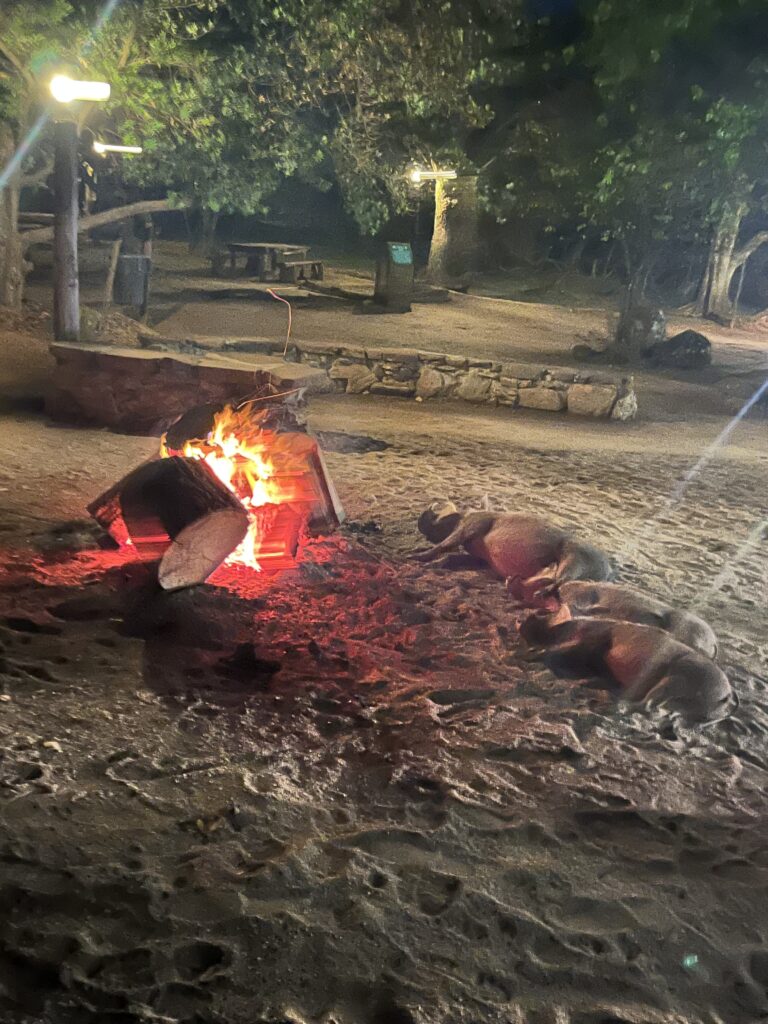
Sleeping warthogs
eSwatini’s Mlilwane
Mlilwane is the perfect change of pace after Kruger: quieter, greener, more relaxed.
Day 1: arrive, a walk, the pool, buffet dinner
Day 2: horse riding or hiking, an optional trip to other parks, another relaxed dinner in the evening
This is often where the feeling kicks in: “Now I’m really on holiday.”
St Lucia and iSimangaliso — close to nature and full of life
St Lucia is ideal for two nights. You can combine, very comfortably:
wetlands atmosphere
beach and coastal air
an optional boat tour on the estuary
With a bit of luck you’ll see hippos in the streets in the evening. What matters: keep your distance, don’t crowd them, never stand between an animal and the water, and don’t force a “selfie moment.”
Finishing in Durban or the Drakensberg
Durban is logistically simple and a pleasant finale if you’d still like a city-and-coast evening.
The Drakensberg suits you if you’d rather exhale into nature than into a city. In that case, swap Durban for a night in the mountains and plan your departure accordingly.
FAQ
How many nights in Kruger make sense on a 14-day trip? Four nights is ideal. It gives you safari depth without overloading the route.
Is self-drive possible in Kruger, or do you need ranger drives? Self-drive works very well. Ranger drives are an upgrade if you want more context and guided dynamics.
Is a night drive in Kruger worth it? Yes, very much so. Animal behaviour changes noticeably after dark. But never on your own — that’s not permitted.
What’s the advantage of going north to south in Kruger? You get more variety in landscape and wildlife. The experience also builds up beautifully as a story arc.
Can Graskop and eSwatini fit into the 14 days? Yes — one night in Graskop and two nights in Mlilwane works very well.
What can you do in Mlilwane? Horse riding, hiking, relaxing by the pool, and a generous buffet in the evening. Trips to other parks are also possible.
Are hippos dangerous in St Lucia? Hippos are animals, and animals run on instinct — often shaped by bad experiences with people. Distance and respectful behaviour are essential, especially at night.
St Lucia or Sodwana Bay — which suits better? St Lucia is versatile and ideal for iSimangaliso. Sodwana leans more toward “sea and reset,” often with a snorkelling focus.
Is Hluhluwe-iMfolozi worth adding to Kruger? As an addition, yes. As a substitute, no. Hluhluwe is hilly and sightings aren’t always straightforward.
Durban or the Drakensberg to finish? Durban is easy for departures and a bit of an urban feel. The Drakensberg is better if you want the trip to wind down quietly, close to nature.
Photo by: duncan-mcnab-DcpLhoT5NvE-unsplash
Botswana is a dream destination. The government has leaned into exclusivity from the start — which is also why a Botswana trip tends to cost more than one in South Africa. In Botswana (and in Namibia too) there are regions we don’t travel with clients as standard: the Kalahari Desert, the Kgalagadi Transfrontier Park, and the area between Moremi and Kasane. That doesn’t mean we won’t happily plan it for you — but these are demanding trips that call for a certain adventurous spirit. The Chobe River and the Okavango Delta are both spectacular — but they’re two completely different worlds. Chobe is big, powerful, “earthy,” and rich in visible wildlife density. The Okavango Delta, by contrast, is quieter, more layered, water-carried, and feels like a nature poem that doesn’t push itself on you — it unfolds.
We can arrange both (and usually do), so it helps to know the differences before deciding: where do we go first?
Chobe National Park at a glance
Chobe is many people’s first encounter with Botswana — and for good reason. The region is known for its exceptionally high elephant density, especially along the river. Safari here is often immediate: you see plenty of animals, sometimes so close you find yourself speaking more quietly without meaning to.
What makes Chobe NP stand out
River safari: Boat cruises are a genuine highlight — especially in the late afternoon, when the light softens and the animals come down to the water.
Big herds, powerful scenes: elephant, buffalo, often lion too — Chobe can feel like a nature documentary in real time (much like Etosha National Park in Namibia).
A great “welcome energy”: if you’ve never been to Botswana, this is where you quickly understand why the country has such a strong reputation.
Who Chobe suits especially well
Travellers who want to see a lot and love quick, rewarding sightings.
Anyone who likes river and wildlife density in one package.
People who like to start a trip with a “here we go” feeling.
Okavango Delta at a glance
The Okavango Delta is its own category entirely. It’s a living system of waterways, islands, papyrus, lagoons, wildlife, and light. Safari here doesn’t just happen on the road — it happens on the water, and above all, on nature’s own rhythm.
What makes the Okavango so special
Waterscapes and island living: many camps sit in genuine seclusion. When we stay in one of the tented camps, you’re right in the middle of it — you might hear hippos grazing at night and not get a wink of sleep :D.
Safari as a mood, not a checklist: you don’t just experience animals here, but space, sound, birdlife, silence — and that particular Delta magic. This isn’t about ticking off the Big Five — though with Africanrovers, it’s never really about ticking boxes anyway.
Mokoro and quiet paths: in many areas you can travel by mokoro (a traditional dugout canoe — these days made of fibreglass) — one of the quietest and most wonderful ways to experience Africa.
Who the Okavango Delta suits especially well
Travellers looking for depth.
Couples, honeymooners, or anyone who values privacy.
Anyone willing to factor in the logistics and budget for something truly special.
Deciding by travel style
To help you reach a clear decision faster, here’s a practical way to think about what really matters to you.
1) You love water and boat trips
Start with Chobe if you want to experience the river “big and alive”: wide open water, plenty of animals along the banks, classic boat-safari feeling.
Start in the Okavango if you’d rather experience water as a “world of channels and islands”: quiet, intricate, intimate.
Rule of thumb:
“I want photos with plenty of animals by the river” → Chobe
Then Chobe is usually the stronger opener. It gives the start of your trip a real punch — and you’ll very quickly understand why Botswana makes safari fans so happy.
3) You want exclusivity, quiet, and a “once-in-a-lifetime” feeling
Then we start in the Okavango. It sets the tone: slow, high-quality, deep. Many travellers experience the Okavango as the “crowning finale” — but just as many love starting there, because it switches your nervous system straight to “arrived” mode.
3) You’re travelling with family or safari first-timers
Chobe NP first is often ideal: it’s more accessible, the experience is immediate, and the rhythm of a safari becomes clear quickly.
The Okavango Delta then becomes a beautiful second step.
Order-of-travel scenarios
Here are three scenarios that have proven themselves in practice. Think of them as mental models.
Scenario A: Chobe first, Okavango after
Who it’s for: first-time visitors, families, “we want to see a lot,” or anyone who wants to start with a “wow” factor. Advantage: you enter through wildlife density and river safari, and finish in Delta magic. Feeling: from powerful → to poetic.
Scenario B: Okavango first, Chobe after
Who it’s for: couples, honeymooners, travellers who want a slower start and prefer to arrive gently first. Advantage: you begin with the more exclusive, quieter experience — afterwards, Chobe feels like the lively finale. Feeling: from still → to spectacular.
Scenario C: Okavango as an “island” in the middle
Who it’s for: travellers who want both, but need balance. Advantage: the Okavango becomes the emotional centrepiece — Chobe and another building block (e.g. Savuti/Moremi, depending on style) frame the Delta on either side. Feeling: dramatically well-rounded, especially over 10–14 days.
Logistics
Botswana isn’t a country you drive through “on the side.” Especially in the Okavango, logistics play a real role — not as a problem, but as part of the experience.
What to generally expect:
The Okavango often means a flight, or very long drives. Many Delta camps are only reachable by light aircraft. That’s part of the exclusivity: you’re not there by chance, you’re there deliberately.
Chobe is usually easier to connect to. Depending on how you combine Botswana into your trip (say, via Livingstone/Victoria Falls or via Namibia), Chobe often feels more straightforward logistically.
Travel timing shapes the experience.Water levels, vegetation, and animal movement all shift through the year. That’s true for both regions, but it’s especially noticeable in the Okavango.
Photo by: colin-watts-newE0057quQ-unsplash
FAQ
How expensive is the Okavango Delta?
Without getting into numbers, the honest answer is: the Okavango Delta usually sits in a higher price bracket than Chobe NP, because the camps tend to be remote, logistics are more involved (often light aircraft), and the whole infrastructure is built to be more exclusive. In return, you generally get more privacy, a more immersive nature experience, and a particular kind of quiet. You can also plan the Okavango “smart” — for instance with fewer nights, but very deliberately chosen ones.
Can Chobe and the Okavango be combined well in one trip?
Yes — it’s actually one of the loveliest combinations in southern Africa, because it brings together two completely different safari styles: river and herds in Chobe, water-labyrinths and islands in the Okavango.
Which order is better for first-time visitors?
For many people, Chobe first is easier, because the experience is immediately tangible. But if you’re more the quiet, savouring type, Okavango first can be the more magical way in.
Do I even need to choose?
Not necessarily. It comes down to your budget and how much time you have. From around 10 days in Botswana, you can usually fit both in comfortably — with less time, it’s generally better to focus on one.
The bottom line
Chobe first, if you want to start with wildlife density, river safari, and powerful energy.
Okavango first, if you want stillness, exclusivity, and that “Delta feeling” as your opener.
And if you love both: let the Okavango become the dramatic heart of the trip — then the whole journey feels like a composition, not a list.
Photo by: charl-durand-_YVhRwUlL4Y-unsplash
Mosquito insence burning
Health aspects always play a role when traveling abroad. South Africa is on a different continent and may seem exotic – but in terms of diseases, we don’t have that much to offer here.
Vaccinations against yellow fever or typhoid are unnecessary. Should you already been vaccinated against yellow fever it’s good to know that the yellow fever vaccination protects you for a lifetime. If you have been to a yellow fever country before entering South Africa, the South African government will want to see a vaccination when you enter South Africa.
How is malaria transmitted?
Malaria is transmitted from an infected person to a person who is not yet infected by an insect bite from a mosquito. The infected person can also be an animal, which is why it is not possible to eradicate malaria. The female Anopheles mosquito sucks blood and uses her saliva to transmit the pathogens, for example Plasmodium falciparum, to the next person she bites. There are six species of Plasmodium that cause malaria in humans. The best known and most widespread species in parts of South Africa is malaria tropica, which is transmitted via the single-celled parasite mentioned above.
Plasmodium falciparum travels with the blood to the liver, where it multiplies but does not yet produce symptoms. Then it travels around in the body and destroys red blood cells, which of course is not cool.
How do you protect yourself from infection?
The best protection against mosquito bites is to wear long-sleeved clothing and long pants during dusk.
Try to cover open areas of skin as much as possible. Mosquitoes are usually out and about at dusk – hardly during the day. In the evening around the campfire in the camp in Kruger National Park, you should wrap up well and rub the unprotected areas with a mosquito repellent. Some mosquitoes are already immune to the sprays that are still used in many places to fumigate hotel rooms, for example. DEET is not only harmful to the environment, it is also not ideal for us humans (as part of the environment…).
There is no vaccination against malaria that really protects. The ‘RTS,S’ vaccine developed over 30 years of work prevented just 30% of malaria cases in initial trials in 2019. Since then, nothing more has been heard of ‘RTS,S’. Prophylactic medication can be taken, which comes with a ‘nice’ range of side effects that can ruin your vacation.
What to do?
Like any native mosquito, Anopheles mosquitoes are attracted to the human scent, which signals to them: 5 liters of delicious blood are HERE. Insatiable…. anyway. So the aim is to cover it up. Essential oils immediately spring to mind, don’t they? And: exactly! The right mixture also helps to distract the mosquitos.
Fanning mosquito coils (the same as the electric mosquito plugs) can help, but these beasts usually contain synthetic pyrethroids, which are harmful to children and babies. Oh! And not for adults? I don’t like being taken for a ride. Synthetic insecticides cannot be healthy by definition, because they kill insects. The poisoned survivors may be eaten by a bird, which in turn may be eaten by another predator. The poison ends up in the environment and who is at the end of the food chain? Well, us (and a few other apex predators and pigs, which we also eat, and anchovies, which…). Poison is not a solution for people who think holistically.
You have to reapply the natural mixtures of essential oils every 2 hours, because the odorants are ethereal, they evaporate. Recipes can be found here. It also helps to be near someone who always gets stung :D. In homeopathy there is the malaria nosode, which you can obtain abroad. In Germany, where people are particularly interested in eradicating naturopathy, you cannot get this medicine.
Infected – and now?
Unfortunately, the first signs are relatively unspecific: Headache, fever and chills. But, if you have been in a malaria area and 14 days later these symptoms appear, then it seems obvious to do a malaria test. What is good to know is that even without any treatment, only about 200 out of 1000 seriously ill people die. In 19 years, 25054 travelers from the UK contracted malaria, 184 of whom died. First of all, this means that many (an unknown number that is being concealed from us. However, in the years in question, around 39600000 Brits traveled abroad every year) were bitten, but were able to fight off the infection on their own (with their own immune system). Only 25054 fall so seriously ill that they seek medical help. Of course we don’t know which foreign countries the Brits traveled to, certainly not all to an area where there are Anopheles mosquitoes. But as with all statistics, it is important not to lose sight of the proportions. I’m just saying: SARS-COV II.
So if you are infected with Plasmodium falciparum, then artesunate, a derivative of mugwort, will help you. This is also very interesting, because for the reasons already mentioned, herbal medicine has a hard time in Germany and Artemisia annua has been used for thousands of years in traditional Chinese medicine, but also for hundreds of years in alternative medicine.
The difficulty of the matter is bioavailability, i.e. you can’t take so much mugwort that it actually helps…but hold on! There was also homeopathy, where everything is potentized so that it is more effective.
Everyone is to find what they believe in and acts accordingly.
White Rhino with calf Shamwari Private Game Reserve
My guests arrived on the 26 of October and told me yesterday on the occasion of our last supper that they were really worried as I wasn’t there waiting for them when they entered the arrivals hall. What started with a fault (I was 10 minutes late to pick them up) turned into a fabulous trip along the Gardenroute. But the minutes they waited for me to arrive were quite unsettling as they only knew me from video calls and came to Cape Town trusting that everything would be in order – and now their tourguide was mia.
They stayed in Cape Town for 5 days and we ticked all the sightseeings but it’s the slightly unusual (scary …) things that they remember best like when we went to eat at a really dodgy looking place 😀 – but they trusted me and were stunned by the experience. As with every trip I also learn a lot – every guest is different and for them to have the best experience it is adamant to find out about their likes and dislikes during the planning phase and how far I can take them out of their comfort zone to create a good lasting memory and not a shock.
On the 31st we packed the car and drove towards Hermanus. Due to the recent flooding the scenic coastal drive was still blocked and we couldn’t do what was planned. Flexibility is a prerequisite when visiting Africa – even the Western Cape which is a very europeanised part of the country – Africa light as I like to call it. The guests went on a whale cruise and had the most amazing encounters – they loved their accommodation and the dinner.
Speaking of accommodation: Dear future guest, please be specific when we talk about your accommodation. I do not have to like it – my taste might be different from yours. Tell me what is important to you so I can find the hotel/B&B/tent 😉 that you enjoy the most.
We stayed on a working farm near Swellendam, in Plettenberg Bay and in St. Francis – very different accommodations – before reaching the highlight of the tour: Shamwari Private Game Reserve. There are 7 lodges on the reserve, the clients stayed at Eagles Crag and absolutely loved it. The game drives, the meals, their room, the service. The Rhino picture was taken by them. It rained in the evening and the roads turned into muddy catastrophes – I broke quite a sweat when I picked them up again.
We flew back from PE to Cape Town and ended the trip in Stellenbosch with a relaxing stay at Lanzerac wine estate. Today our journey ends and we will leave for the Airport in a few hours. All guests are the same when it comes to this part of the trip – time flew by. A good thing about our brains and hearts: they store memories that last a lifetime.